Avalanche transceivers can transmit and receive signals (hence the name, transceiver). They use one or more antennas for these purposes.
All modern avalanche transceivers use two or more antennas when searching. Having multiple antennas allows the transceiver to display a direction indicator.
Transceivers with multiple antennas estimate the location of the transmitting beacon by analyzing the relative signal strength of the x- and y-axis antennas. The Pieps Pro IPS is unique because analyzes the signal on both antennas simultaneously. All other multiple-antenna avalanche transceivers alternate between analyzing the signal strength on the individual antennas. This YouTube video uses the analogy of attempting to determine the location of a sound by listening with both ears simultaneously versus by alternating between listening with your left and right ear.
All avalanche transceivers transmit on one antenna. The primary benefit of multiple antennas occurs during searching as explained below.
Interference-based Transmitting
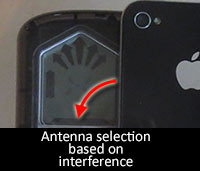
Many Pieps transceivers have a feature where they will transmit on the shorter (i.e., x-axis) antenna if the transceiver senses interference with other electronics (e.g., a cell phone) or if there is damage to the primary antenna. You can test this by waking up your phone (you don't need to be on a call) and holding it against the transceiver as shown in this picture. The display will then show that the shorter antenna is transmitting.
The Pieps DSP Pro, Pieps DSP Sport, Pieps Micro, Pieps/BD Powder/Recon, Pieps Pro IPS, Pieps/BD Pro/Guide, BD Recon LT, and Pieps Vector have this feature.
Orientation-based Transmitting
All avalanche beacons transmit on a single antenna. If that one antenna ends up pointing vertically (which will theoretically occur 25 percent of the time), the range at which a searching transceiver can 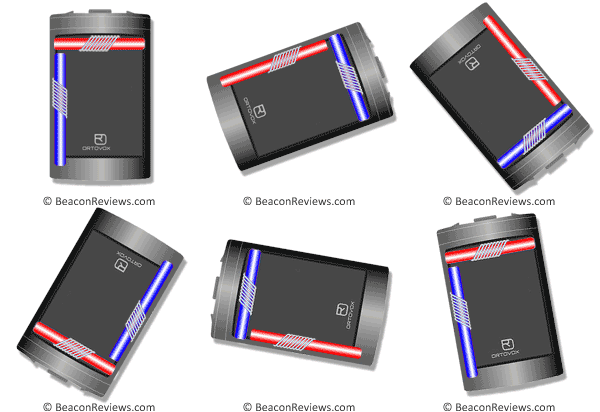 receive the signal is significantly reduced because the vertically oriented antenna broadcasts flux lines that are more difficult for searching transceivers to interpret.
The Ortovox 3+, Ortovox Diract, Ortovox Diract Voice, Ortovox S1+, and Ortovox Zoom+ have a unique feature where they will transmit on either of two antennas based on the transceiver's physical orientation. If these transceivers sense that the primary antenna is aimed skyward, they will switch to transmitting on the horizontally oriented antenna. In the adjacent animation, the red antenna is transmitting.
Transmitting on the horizontally oriented antenna can potentially increase the distance at which the searching transceiver will receive the signal.
Ortovox has a patent on the "orientation-based" transmitting.
The number of antennas affects an avalanche transceiver's ability to direct a searcher to a transmitting transceiver.
Single antenna transceivers have a long reception range when the searching beacon is in line with the transmitting beacon's flux lines, but they have a significant loss in range when the antennas are not aligned. And single-antenna beacons cannot display a direction indicator, although some single-antenna beacons do display a distance indicator. The inability of single-antenna transceivers in this digital age means they should be retired.
Two-antenna transceivers have two antennas mounted perpendicularly. They compare the strength of the signal that is received on each antenna to calculate the location of the buried beacon. This allows the transceiver to guide you to the victim by displaying a direction indicator.
Two-antenna beacons retain a strong signal even when they are turned 90° because the second antenna is then aligned with the transmitting beacon's flux lines. (The Ortovoxes and Pieps are especially good at receiving a signal when the antennas are turned 90°.) Two-antenna transceivers, as with single-antenna transceivers, are unable to resolve spikes. This means that they may incorrectly locate the closest position during the fine search.
Three-antenna transceivers have the advantages of two-antenna beacons (i.e., they can display a directional indicator). They also have a tiny, vertically-mounted third antenna which only turns on when you get near the victim. The third antenna greatly reduces, or eliminates, spikes (where the beacon mistakenly points to a location a meter or two from the victim).
Released in 1997, the Tracker DTS was the first transceiver with two antennas. It quickly gained the reputation as the easiest avalanche beacon—it certainly was. The DTS used its two antennas to display lights that directed you toward your buried friend. Many professionals discounted the Tracker as being a beacon for novices, but ease of use is important when someone is dying.
The Pieps DSP was the first transceiver to add a third antenna. Today almost all digital transceivers have three antennas (an exception being the DTS which is still being sold). These avalanche transceivers not only offer the directional and distance benefits of two-antenna beacons, but they also eliminate problems with spikes. A "spike" is when the strongest signal is up to two meters away from the transmitting beacon. You won't notice whether a transceiver can handle spikes when searching for a beacon a few inches under the snow (as is typical during practice), but bury the transmitter under a meter or two of snow, and the difference between a two-antenna and a three-antenna beacon is significant. The three antennas ensure that there are antennas pointed in three dimensions (i.e., forward/back, left/right, and up/down). The beacon can then use the relative strength of the signal on each antenna to precisely locate the transmitting beacon. The Ortovox Patroller, Ortovox D3, and (most) Ortovox X1s also have three antennas, but in my testing they did not accurately resolve spikes. The Pieps DSPs (and probably others) have a 4th antenna that is only used during its self-test.
Having two or more antennas is the most important factor in performing a rapid coarse search in a variety of conditions with a variety of rescuers. And three-antennas greatly improve the fine search in all but very shallow burials. I know some old-timers will disagree, but only until they do serious tests with multi-antenna transceivers. I was a hardcore Ortovox F1 fan and swore that multiple antenna transceivers were for dummies—until I used one and discovered the benefits. That isn't a sales pitch, rather it is based on my experiences with many beacons.
There's a rumor that if two transceivers are very close (with one of them transmitting), the second transceiver's antenna will be damaged. I've had numerous conversations with electronic gurus and they tell me this is an urban myth. They respond, in part, "If the low power from a transceiver could damage a nearby antenna, it would damage its own antennas." Similarly, I've been told that leaving a transmitting transceiver on a steel table will cause the antenna to detune. I'm no expert on this topic, but the gurus tell me it is totally bogus.
However, avalanche transceiver antennas are relatively fragile, and dropping your transceiver can damage its antenna. It is important to periodically test your transceiver's transmission and reception range to make sure it's working correctly.