The Ortovox 3+ was released in 2010 and discontinued in 2020-2021.
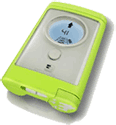
Ortovox 3+ avalanche transceivers have been recalled due to a software error. Read about the recall. (Ortovox released another software update for the 3+ in June 2020.)
Summary: The Ortovox 3+ is a small, three-antenna, avalanche transceiver with a modest range. It has Ortovox's innovative transmitting logic that can increase the distance where other transceivers can receive its signal. The 3+ does an good job of "suppressing" multiple burials and handles spikes well. The no-nonsense display makes it easy to locate the victim. The 3+ supports software upgrades and comes in a choice of colors: green apple and phantom black.
Notice: There is an have been online discussions (since archived) about the 3+ getting confused ("quirky") during the coarse search. I did not see this during my testing, but I've heard reports from several people. My trusted colleague, Jonathan Shefftz, wrote this article about the oddity. His article contains two videos (one and two ) that show the issue. I talked to the top people at Ortovox who say that the problems people are reporting are the result of background interference (and in Jonathan's case, the video camera), but I'm not convinced. In Jonathan's case, he saw the problem before recording it with his camera. Ortovox feels strongly that this is can not be recreated in the backcountry. Although I have not personally seen the quirks, I've now heard about it from multiple people. Given the quirky searching and multiple recalls , I've downgraded the 3+'s score to 3.5.
Searching: The 3+ has a modest reception range. Version 1.0 first displayed the distance indicator and if you waited a few moments, it displayed the direction indicator. After a few more moments, it emitted the audio indication. Version 1.1 reportedly displays all three indications at once.

The 3+ has a recommended search strip width of "up to 40 meters." As with all transceivers, it's better to make narrower search strips than to end up at the toe of the avalanche without receiving a signal.
The direction is indicated with an arrow that can point in seven different directions. When pointed straight ahead, the arrow is solid black to indicate that you're aligned with a flux line. The estimated distance to the transmitter is displayed in the center of the screen.
While searching, the audio indication is a digital beep. During the fine search, the cadence and pitch increase.
As with a few transceivers, if you are headed in the wrong direction (which can easily happen, since transceivers simply align you with the transmitting beacon's flux lines) you will need to notice that the distance is increasing and turn around. (Many transceivers will display a U-Turn in this case, although some of these are overly sensitive and create additional confusion.)
In our testing, the 3+ did an excellent job during the fine search.
Spikes:Spike handling is excellent.
Multiple Burials: The 3+'s handling of multiple burials is similar to most of the top-ranked transceivers: you press a button to "suppress" (aka, "mark") the nearest beacon and advance to the next. During my testing, the 3+'s marking was excellent.
The 3+ indicates the number of transmitters by displaying up to three people just below the distance indicator. If four or more beacons are transmitting, the transceiver displays "4+" to the left of the people.
The 3+ will initially direct you to the closest transmitter. After locating the person with your probe, press the Mark button on the transceiver to ignore the current beacon. That person will then be displayed on a black background and you will be directed to the next person.
If several beacons are transmitting and the signals are overlapping (a situation that will prevent any transceiver from accurately searching), the 3+ will display the estimated distance to the closest transmitter without displaying a direction indicator.
The 3+'s handling of multiple burials is solid. There is only one button on the face of the transceiver, so there is no mistaking which button you should press. The indication of the number of burials is clear and obvious. And during our testing, the marking featured worked perfectly. Simply press the button once (even if the transceiver isn't held perfectly still) and the 3+ will point you to the next transmitter. I tested this feature with both two and three transmitters, using the same brands as well as different brands of transmitters, and the marking was excellent.
The 3+ does not include the ability to unmark a previously marked transceiver (which the Barryvox S, Pulse and S1 do). I think that was a good decision, as the additional user interface probably adds more confusion than benefit. If you want to unmark a previously marked transceiver, momentarily toggle the 3+ between send and receive.
(Read about multiple burials and transceiver marking on AvyRescue.com.)
Orientation-based Transmitting: The 3+ uses Ortovox's " orientation-based antenna" technology that selects the transmission antenna based on the device's physical orientation.
This is a nifty concept that should improve the range where searchers will receive your signal and make it easier for the searching transceivers to find you if the victim's beacon is buried vertically. Otherwise, the beacon will transmit just like any other. I've tested this feature just enough to know that it works.
Controls: The 3+ is powered on by turning the knob that secures the battery. The markings to turn the device on, off, and to open the battery are a bit difficult to read and somewhat obfuscated by the 3+'s logo. You'll figure it out within a few minutes after purchasing the 3+, but hand the unit to a novice they may struggle turning it on. It is possible to turn on the 3+ without realizing that it is in search mode.
The knob (or maybe it should be called a dial), is not glove or mitten-friendly. And if you turn it too far, the entire knob comes off (as if you want to replace the batteries). It's a bit of a pain to reattach. Of course, you only need to deal with the knob to turn it on/off (unlike the Tracker3 which also has a tiny dial, but it is only used to change between off, transmit, and search)
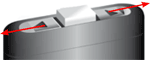 Switching
to Transmit: To change from transmit to search mode, you simultaneously slide
two switches outward. There's no chance you'll do this by mistake and it's easy to learn,
but if you hand the 3+ to a novice and start screaming, "Change to search mode!" they
may not be able to do so. This switch is
not a deal breaker by any means and
it will only affect people who haven't used a 3+, but it is worth noting. I think a
single switch that can be in either the Off, Transmit, or Search position is more intuitive.
Switching
to Transmit: To change from transmit to search mode, you simultaneously slide
two switches outward. There's no chance you'll do this by mistake and it's easy to learn,
but if you hand the 3+ to a novice and start screaming, "Change to search mode!" they
may not be able to do so. This switch is
not a deal breaker by any means and
it will only affect people who haven't used a 3+, but it is worth noting. I think a
single switch that can be in either the Off, Transmit, or Search position is more intuitive.
Revert to Transmit: If the 3+ is in receive mode for two minutes without any motion (e.g., if a searcher is buried while searching), it will automatically revert to transmit mode. Sensing motion is good because it prevents the beacon from returning to transmit mode during the search and confusing the other searchers. However, there are valid concerns that reverting to send when a second avalanche strikes may result in a transmitting beacon that is no longer attached to a rescuer. Unfortunately, the automatic reverting to transmit cannot be disabled on the 3+ (or the Zoom+).
Ortovox's decision to use a fixed time period (two minutes) simplifies the user interface (e.g., no menus or tricky button presses). (A limited number of 3+ transceivers were recalled in late-2012 due to a problem with "revert to transmit" functionality. Learn more here.)
Beginning with version 1.1, the 3+ will give an audible warning for 10 seconds before reverting to transmit. That's extremely important (and worth getting the update) or a rescuer's beacon can unexpectedly begin transmitting during a search.
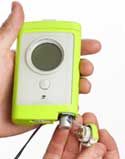
Battery Replacement: The single AA battery is retained with a small, permanently attached, knob. I always struggle while trying to close the battery compartment. The trick, if you can call it that, is to rotate the knob (and that plastic "strap" that connects the knob to the transceiver), must both be rotated clockwise before you attempt to insert the knob.
Comfort: The 3+ is 21% lighter than the Tracker DTS, 13% lighter than the Ortovox S1 and the Pulse DSP , 5% lighter than the Tracker2, and 2% lighter than the Mammut Pulse.
The 3+ has a comfortable pouch-style harness that closes with a (not mitten-friendly) zipper. The elastic retention cord on the 3+ is unique, in that it threaded up through one of the harness straps. This makes the cord short when retracted (about 10 inches) and longer when stretched and extended (about 24 inches). Disconnecting the 3+ from its harness takes a little work, because there isn't a disconnect clasp.
As with all pouch-style harnesses, remember to position the 3+ with its display toward your body.
Group Check: The Ortovox 3+ includes a group check mode (as do several other transceivers as listed in comparison table). Enabling the mode requires a good memory. Here are the steps:
When the group check mode is activated, the screen will display "00" when a properly transmitting beacon comes within one meter, "--" if no transmitter is within one meter, or an error code between "E1" and "E7" if a improperly transmitting beacon is within one meter. The seven error codes are explained in the user's manual.
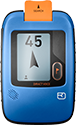
Updates: The 3+ can be updated by taking it to a participating retailer or by mailing the unit to an Ortovox service center. Learn more about updating the 3+.
Self Testing: During startup, the 3+ performs a self test that will display an error code if anything is amiss. The codes are E1 (a problem with the transmitter or receiver), E2 (a problem with antenna reception), E3 (a problem with antenna transmission), or E4 (a memory error).
Battery: The 3+ uses one AA battery.
RECCO Reflector. Ortovox began installing a RECCO reflector in the 3+ in October 2013. ( Read the details .)
| Model: | 3+ |
| Manufacturer: | Ortovox |
| Retail Price: | $310.00 (discontinued 2020-2021) |
| Score: |  |
| Type: | Digital |
| Antennas: | 3 |
| Marking: | Yes |
| Updatable: | Yes |
| Owner's Manual: | Read It |
Pros: Excellent fine search, "orientation-based transmitter." | |
Cons: Modest range reception range, quirky searching. | |